Get In the Zone!
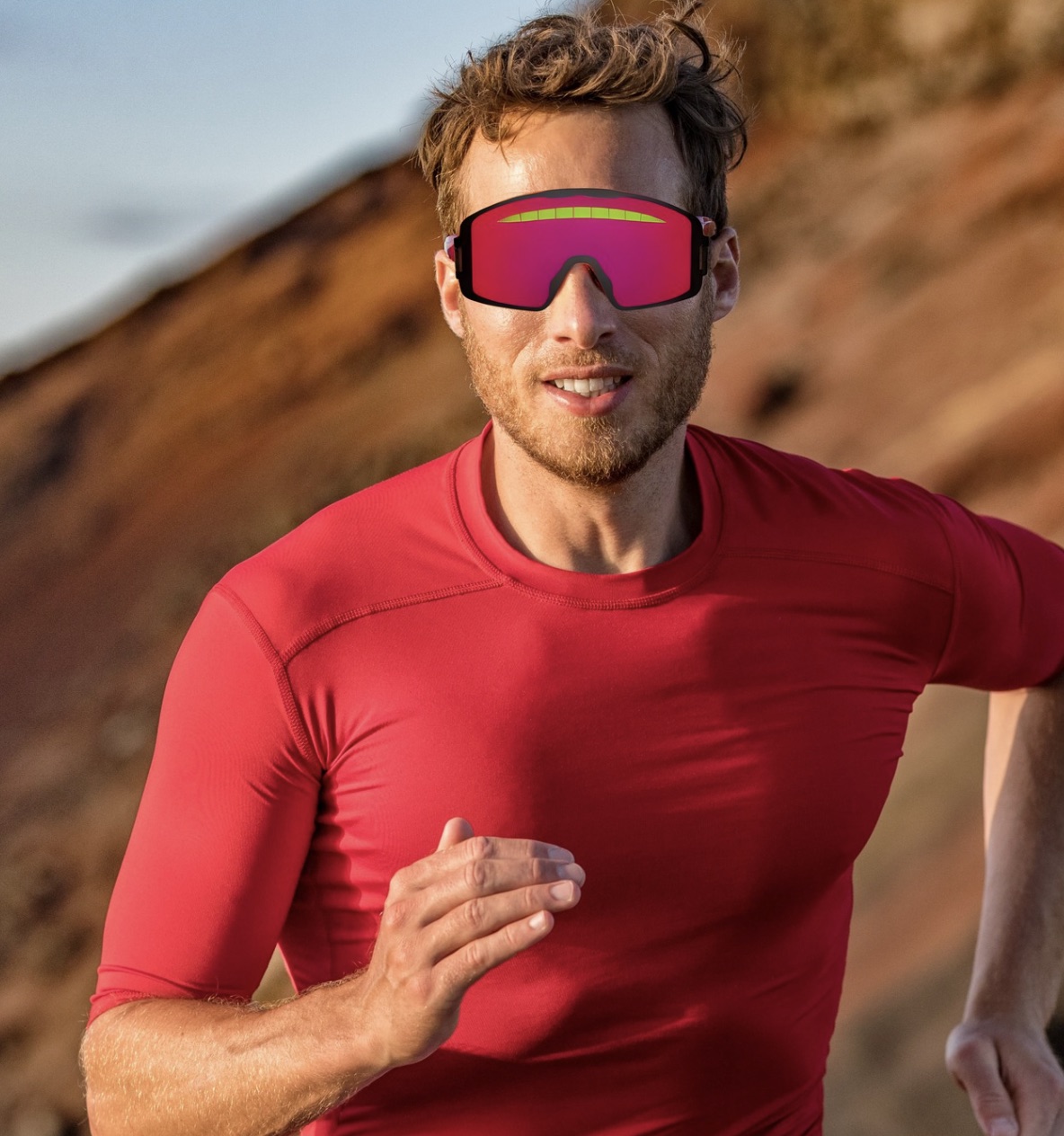
Smart LED running goggles that help novice runners stay in their target heart rate zone through ambient peripheral light without ever breaking stride. Winner of the Best Demo Award at SportsHCI 2025, published as a long paper at MUM 2025 and mentioned at Communications ACM.
Role
HCI Researcher & Interaction Designer (1st Author)
Team
Master's thesis project.
Duration
1 Year (2024–2025)

Publications:
MUM 2025 Long Paper — Into the Zone! ↗
ACM Digital Library · dl.acm.org
SportsHCI 2025 Demo Paper 🏆 ↗
ACM Digital Library · doi.org
Communications of the ACM: Performance Apps Look to Put More Fun Into Fitness ↗
Paul Marks, Feb 2026 · cacm.acm.org
SportsHCI Demo Video — Into the Zone! ↗
Demo Paper, Feb 2026 · doi.org
My responsibilities:
– End-to-end UX research & interaction design
– Physical prototyping (3D printing, ESP32, NeoPixel LEDs, Polar H10 BLE)
– Within-subject user study design & execution (N=11)
– Academic writing, data analysis & conference presentation
Project overview:
Runners rely on smartwatches and smartphones paired with chest straps to track heart rate zones. But these tools often fail to provide constant feedback and can be distracting requiring glances at a screen or reacting to auditory alerts mid-run. Get in the Zone addresses this by shifting heart rate zone information into the runner's peripheral vision through a pair of 3D-printed smart goggles with an integrated ambient LED strip. The system provides continuous, color-coded feedback that runners can perceive without looking away from the path ahead. Conducted as my Master's thesis at the University of Salzburg under Prof. Alexander Meschtscherjakov and Dr. Vincent van Rheden, the project sits at the intersection of sports technology, wearable design, and peripheral interaction.
Design challenge:
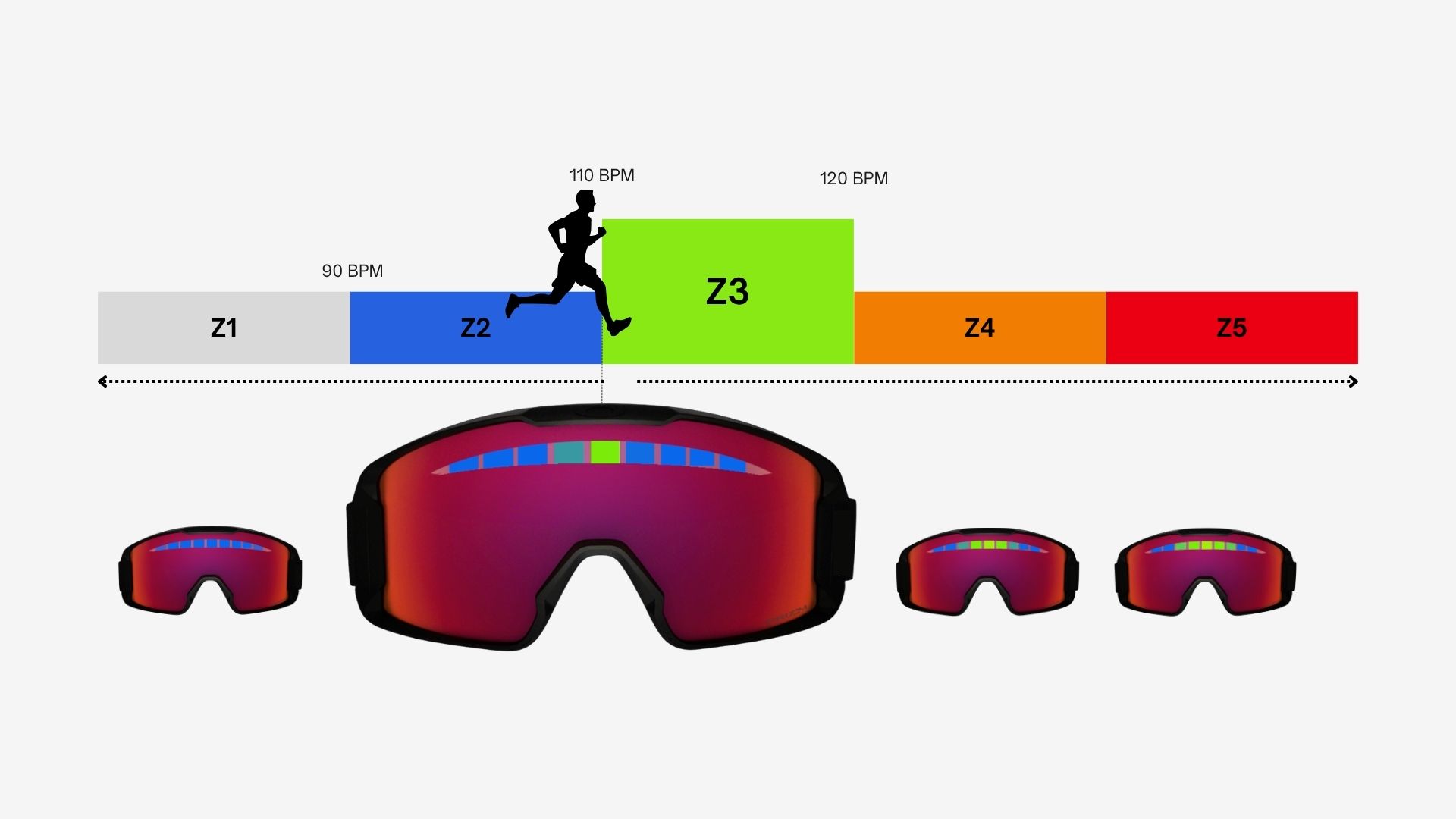
A common use case for smartwatches during running is maintaining a specific heart rate zone for instance, keeping between 110 and 120 BPM. Typically, a chest strap measures heart rate and transmits data to a watch, which displays the current BPM and zone. If the runner strays outside the target, the device responds with vibrations and beeps. But this setup has clear limitations: runners must either glance at the screen or rely solely on alerts that only trigger when they've already left the target range. The challenge was designing a wearable that provides clear, immediate, and continuous feedback, minimizes cognitive load, and integrates into the runner's peripheral vision without occluding their field of view.
How it works:
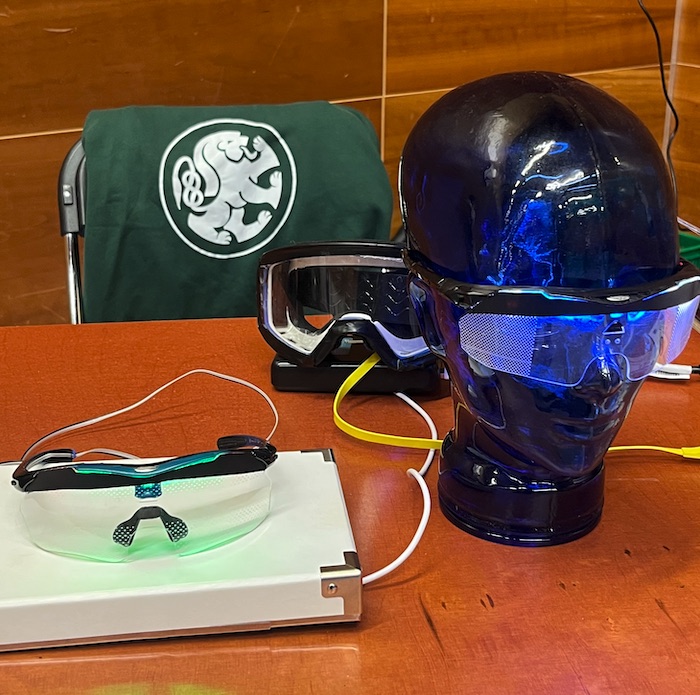
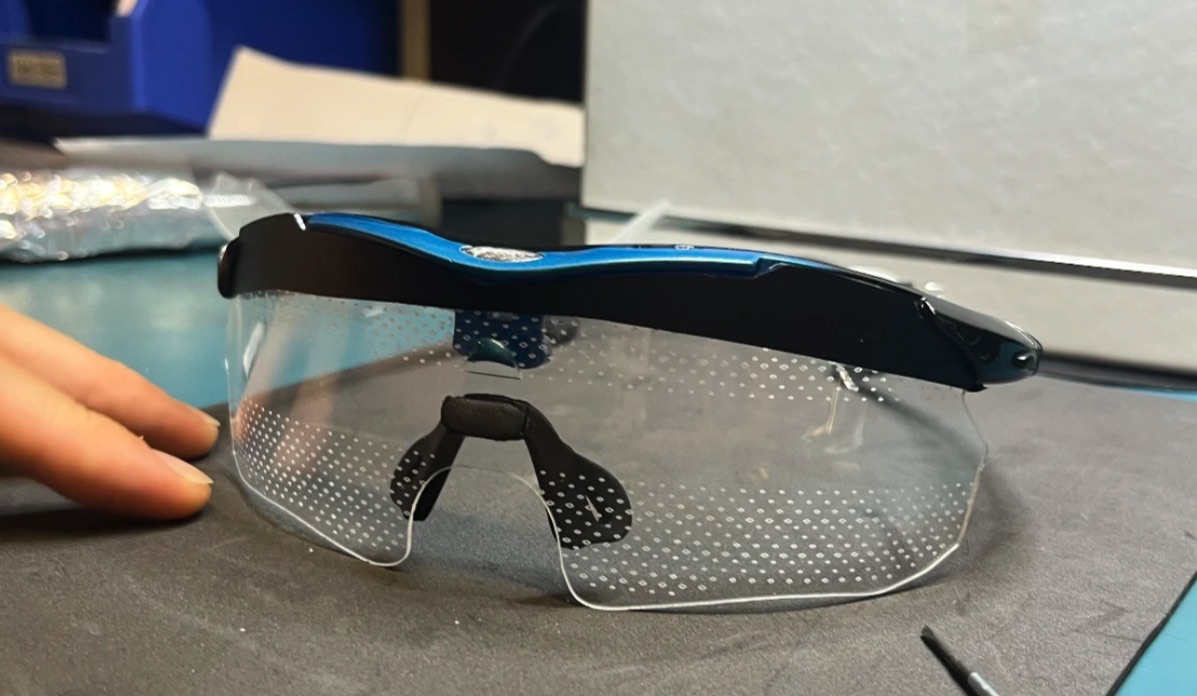
The LED-Goggles feature an LED strip integrated above the lens that displays the runner's current heart rate zone through color. Each zone maps to a distinct color: white for zone 1 (recovery), blue for zone 2 (easy), green for zone 3 (aerobic), orange for zone 4 (threshold), and red for zone 5 (maximum). When a runner transitions between zones, the new color appears at the center of the strip and expands outward creating a smooth, progressive animation that indicates both the current zone and the runner's position within it. Two feedback modes were implemented: reflective feedback, where color continuously reflects the current HR zone, and corrective feedback, which uses increasingly urgent signals (green → red → pulsating → flashing) when the runner deviates from a target zone.
Technical implementation:
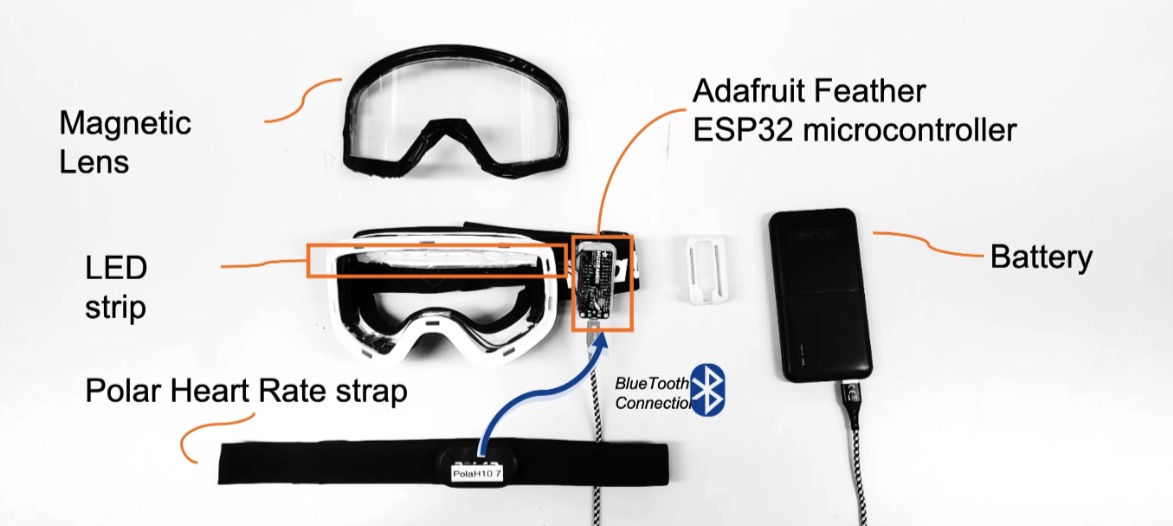
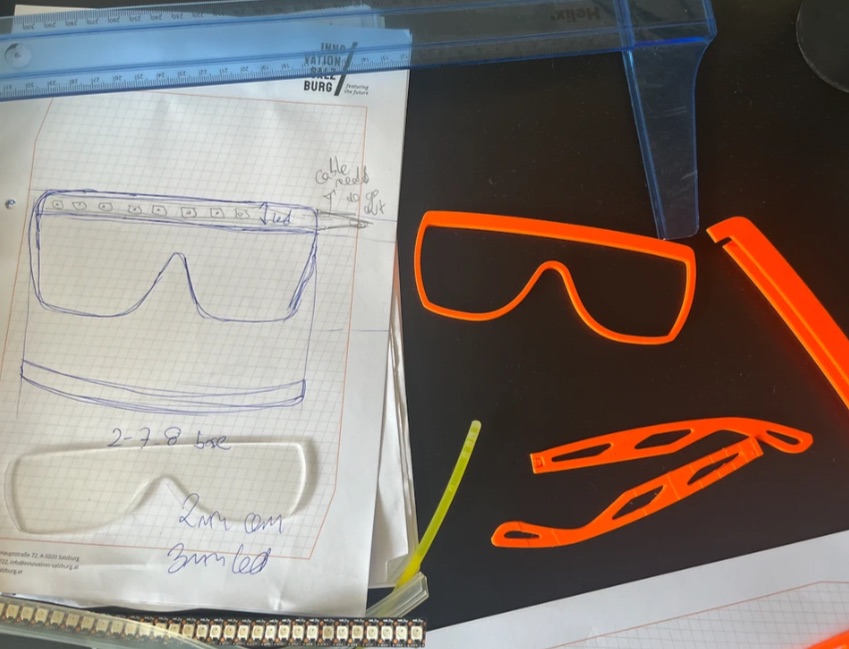
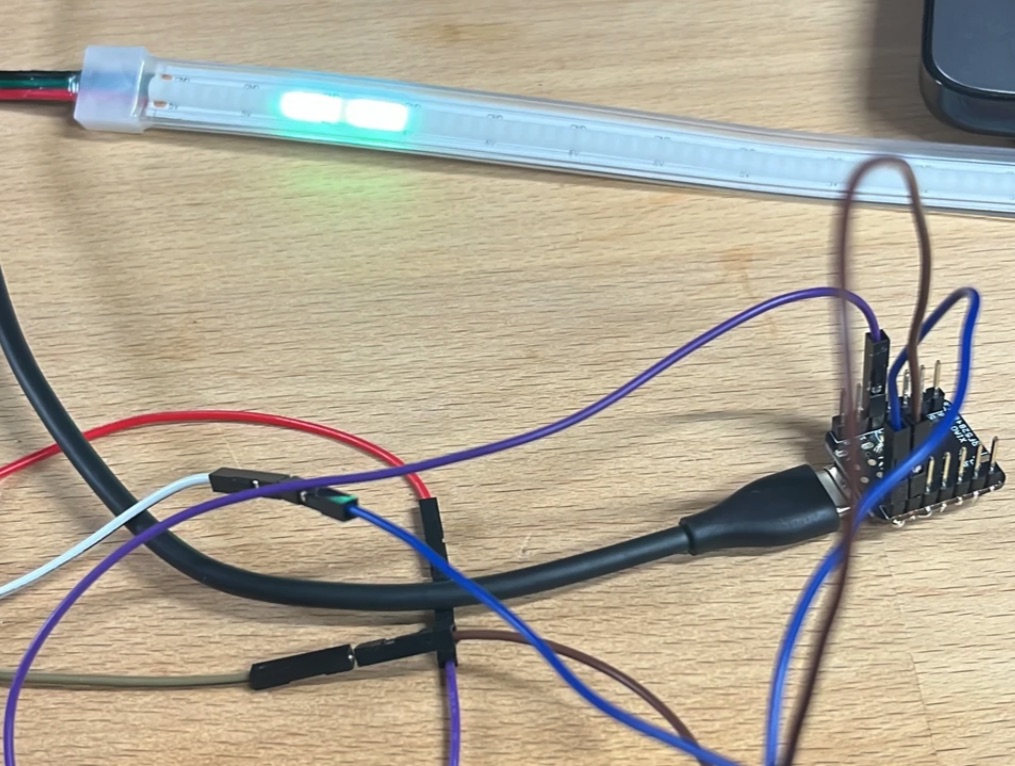
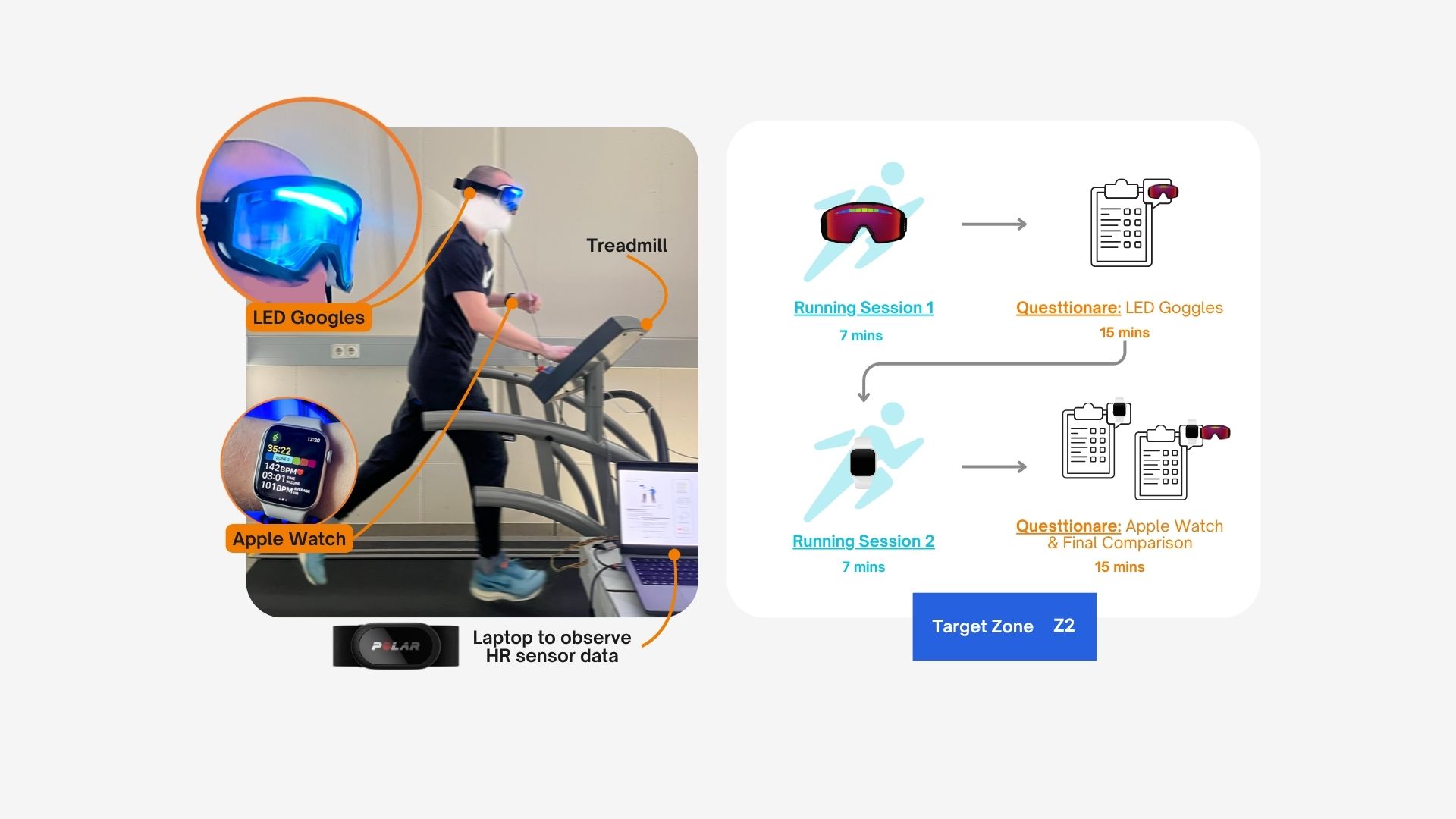
The hardware consists of an Adafruit Feather ESP32 microcontroller receiving real-time heart rate data via Bluetooth Low Energy from a Polar H10 chest strap. A custom Arduino script maps incoming BPM values to personalized HR zones calculated using the Karvonen formula and drives the NeoPixel LED strip accordingly. The number of LEDs lit scales proportionally to the runner's position within each zone, creating a spatial progress visualization. The goggles use a magnetic lens system for easy swapping and a 3D-printed housing for the electronics, powered by a pocket-carried USB battery.
Design iterations:
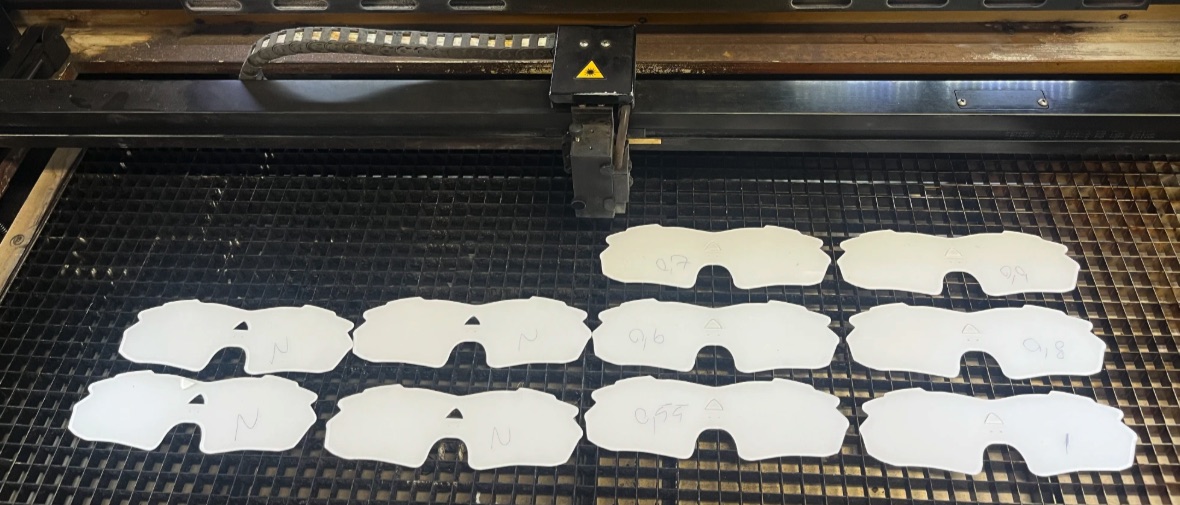
The final design emerged from extensive prototyping across multiple form factors — from swim-style goggles to cycling sunglasses with LEDs in various positions and orientations. We explored variations in color schemes, LED placement, brightness levels, animation speeds, and spatial movement styles (center-outward, edge-inward, static). Early pilots revealed that high brightness with animation velocities out of sync with the runner's pace felt distracting, while static color changes lacked information density. The center-outward animation was selected as the most intuitive for visualizing progress. An intermittent study with 11 participants refined the final color assignments and brightness calibration.
User study (N=11):
We conducted a within-subject lab study comparing the LED-Goggles to a state-of-the-art Apple Watch. Eleven recreational runners (7 female, 4 male, mean age 26.5) completed two seven-minute treadmill sessions (one with each system) aiming to maintain heart rate in zone 2. HR zones were personalized using the Karvonen formula. The Apple Watch provided its standard multimodal feedback: visual zone display, voice announcements, and haptic vibrations. The LED-Goggles provided visual-only feedback to isolate the ambient display's effectiveness. The study received ethical clearance from the university's ethics board.
Results:
Both systems performed comparably, participants spent roughly half their time in zone 2 with each device, with no statistically significant difference in objective metrics. However, participants rated the LED-Goggles significantly higher on helping adjust running pace (p = 0.0403) and providing clear heart rate zone guidance (p = 0.0403). Runners described the goggles as 'not distracting at all and very minimalistic' and noted they could 'focus way better on running.' One participant said the glasses 'helped me run without worrying about if I'm going too fast.' Several described the progressive LED fill as feeling like 'leveling up', an unintended gamification effect that made zone training more engaging. Participants also noted lower cognitive load since they 'didn't have to look anywhere specific' for feedback.
Design contributions:
The paper contributes three design considerations for ambient sports feedback. First, support both ongoing peripheral awareness and layered glanceable feedback, ambient feedback supports flow while glanceable elements provide precision when corrective action is needed. Second, adopt adaptive brightness to ensure effectiveness across varying light conditions. Third, the abstraction of visual representation should harmonize with the use context, in dynamic, in-motion scenarios like running, color semantics need careful mapping beyond what works on static screens. The work advances the discourse on how ambient, embodied feedback can support athletes without disrupting movement flow.
Broader impact & next steps:
The project demonstrates that ambient LED feedback in goggles is a viable, less intrusive alternative to smartwatch-based monitoring. The concept extends beyond running, the paper discusses applications in cycling (indicating upcoming corners via GPS), skiing (horizon feedback from IMU data), rowing (stroke synchronicity), and climbing (arm strain via EMG). Future work includes miniaturizing the electronics with a custom PCB, testing outdoors with varying light and terrain, exploring multi-modal enhancement with subtle haptic cues, and investigating how the balance between feedback availability and 'missability' can best support runner autonomy and flow.
Next project