Katerblau
A 60-foot hybrid motor yacht concept inspired by BMW i8's design language. Designed for a wealthy, eco-conscious user who values speed, luxury, and cutting-edge technology. Combines electric propulsion, lightweight materials, and futuristic aesthetics for coastal cruising in the Mediterranean and Aegean seas.
Role
Industrial Designer & 3D Visualization (Team of 3)
Team
Ege Çelikgöğüs, Merve Karnas, Tilda Gürünlü (University Project)
Duration
1 Semester (Sea Vehicles Design Course)
My responsibilities:
– User research & persona development
– Design concept development inspired by BMW i8
– 3D modeling & visualization (exterior & interior)
– Technical specification & layout planning
– Final presentation & design documentation
Project overview:
Katerblau is a hybrid motor yacht concept developed as part of a sea vehicles design course at university. The brief was to design a yacht for a specific user profile, considering lifestyle, operational conditions, and design criteria. Our team of three designers created a 60-foot (18-meter) planning hull yacht inspired by BMW i8's distinctive visual language — blending luxury, high technology, and environmental consciousness. The name 'Katerblau' references the yacht's signature blue accent color inspired by BMW's electric vehicle line. The project spanned one semester and included user research, design development, 3D modeling, and technical documentation. The final deliverable was a comprehensive design proposal with renderings, floor plans, and technical specifications.
User research & persona:
We developed a detailed user persona: a wealthy celebrity in her late 30s with a busy work schedule and an active lifestyle. She values custom-designed luxury products but is equally conscious about environmental impact and technological innovation. She loves the combination of luxury and high-tech, enjoys sea adventures, and travels frequently for both work and leisure. When on holiday, she prefers intimate gatherings — accommodations for 6 people (close friends and family). Her activities include exploring hidden coves, diving, kitesurfing, and photography. She wants her yacht to serve as rapid transportation between nearby marinas rather than anchoring in open sea for extended periods. Her passion for fast-changing fashion and technology, combined with her enthusiasm for sustainable living, made a hybrid electric motor yacht the perfect choice — offering speed, comfort, and eco-consciousness in one package.
Design challenge & criteria:
The design challenge was balancing competing priorities: speed, comfort, luxury, sustainability, and operational efficiency. Electric vehicles were gaining momentum in 2021 due to environmental concerns, and luxury transportation had historically pioneered technological innovation. We identified speed and comfort as our primary design criteria. The yacht needed to operate between nearby marine locations in the Aegean and Mediterranean seas, prioritizing rapid coastal cruising over long-distance seaworthiness or cost efficiency. This led us to choose a planning hull type (faster but less stable than displacement hulls) and hybrid propulsion (electric battery + diesel engine). Lightweight materials — carbon fiber and fiberglass — would enhance speed without sacrificing structural integrity. The aesthetic challenge was translating BMW i8's automotive design language into nautical form: sharp lines, futuristic silhouette, signature blue accents, and high-tech interior.
BMW i8 design inspiration:
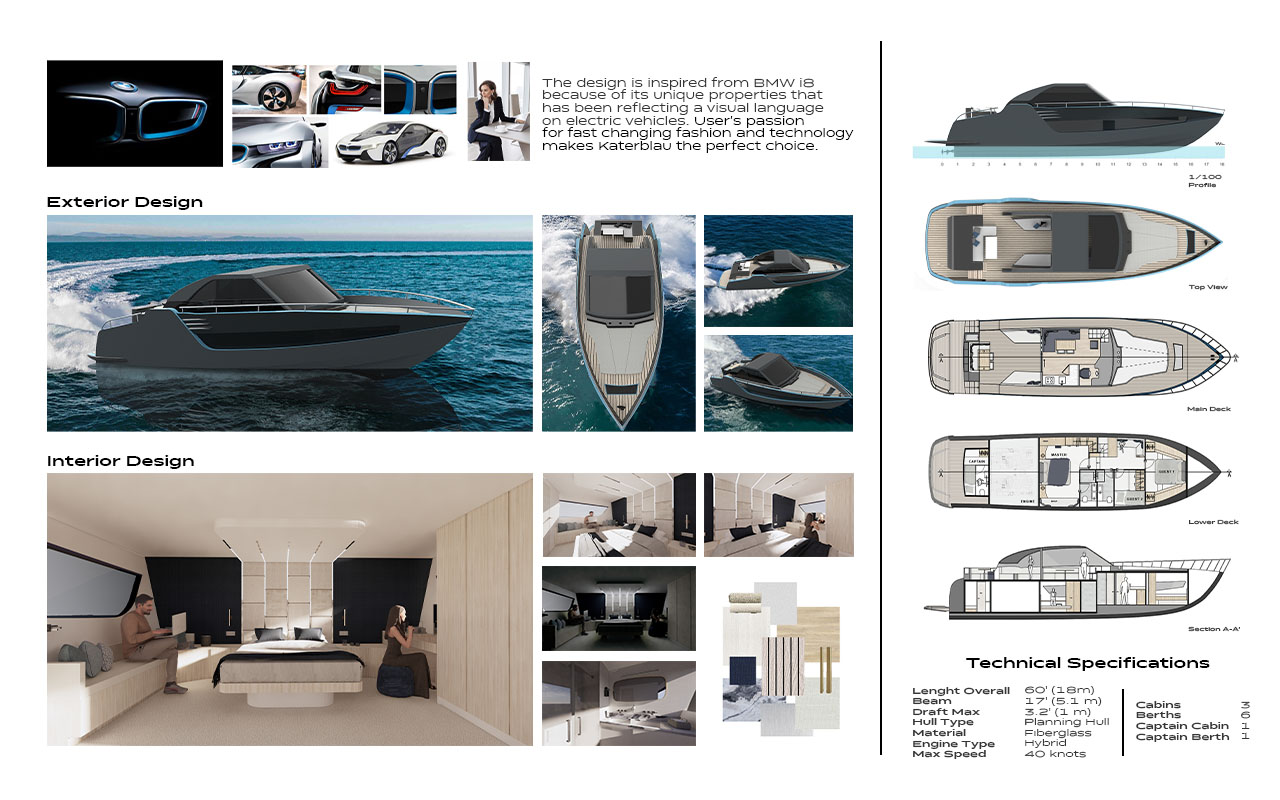
We chose BMW i8 as our visual reference because it exemplified the fusion of luxury, performance, and electric technology that our user valued. The i8's design language — low-slung aerodynamic body, distinctive blue accent lighting, futuristic interior, and carbon fiber construction — provided a roadmap for translating automotive innovation into yacht design. We extracted key visual elements: the signature kidney grille shape reimagined as hull windows, the flowing character lines translated into deck railings and hull contours, the blue accent color applied to LED lighting and interior details, and the minimalist, tech-forward cabin design. The i8's hybrid propulsion philosophy (electric for efficiency, gasoline for range) mirrored our yacht's hybrid system (electric for quiet harbor cruising, diesel for speed). This automotive-to-nautical translation became the project's conceptual anchor.
Technical specifications:
The yacht was designed as a 60-foot (18-meter) hybrid motor yacht with a planning hull, accommodating 6 guests across 3 cabins plus 1 crew cabin. Beam (width) was set at 17 feet, draft (depth) at 4 feet, allowing access to shallow Mediterranean anchorages. The hybrid engine system combines electric battery power (for quiet, low-emission cruising in harbors and protected bays) with diesel propulsion (for open-water speed, targeting 30–40 knots). Materials include fiberglass for the hull and carbon fiber for superstructure components, prioritizing lightweightness to maximize speed and fuel efficiency. The layout includes a main deck with an open cockpit, helm station, and outdoor lounge area, and a lower deck with 3 guest cabins (owner's suite, VIP cabin, twin cabin), galley, salon, and crew quarters.
Exterior design:
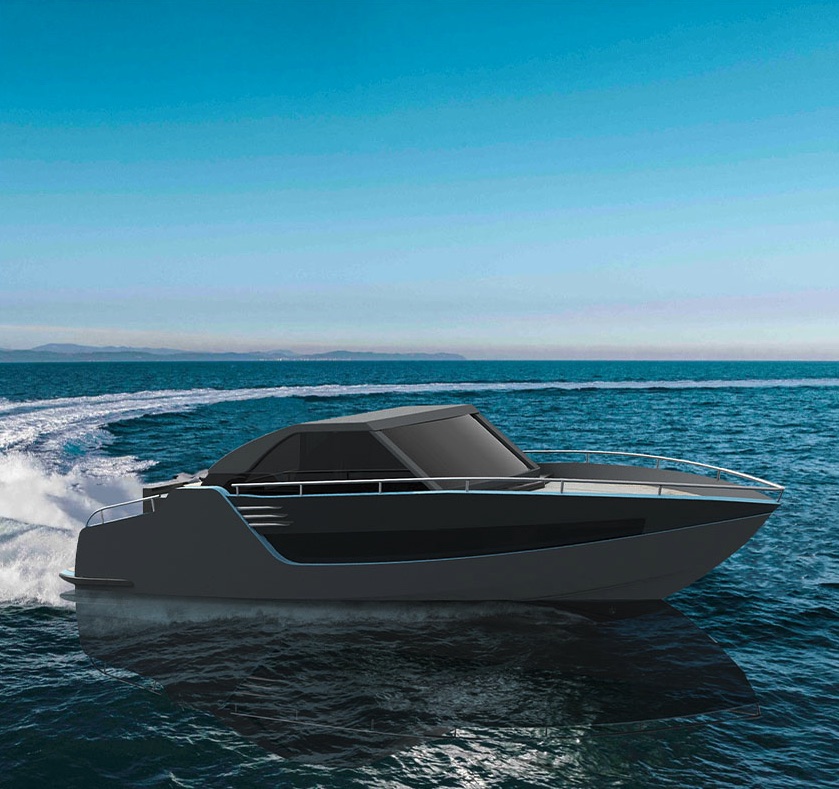
The exterior design translates BMW i8's aggressive, aerodynamic stance into a sleek, fast yacht profile. The hull features sharp, angular lines and a low freeboard (distance between waterline and deck) that visually emphasizes speed. Signature blue LED accent lighting runs along the hull and deck edges, echoing the i8's illuminated kidney grilles and side skirts. The cockpit and deck are designed for active use — ample space for diving gear, kitesurfing equipment, and photography sessions. A retractable swim platform at the stern facilitates easy water access. Large hull windows and panoramic windshields maximize natural light and coastal views. The color palette combines matte dark gray or black hull with white superstructure and blue accents, creating high contrast and modern appeal.
Interior design & comfort:
The interior prioritizes comfort without sacrificing the tech-forward aesthetic. Drawing from BMW i8's minimalist cabin, we designed clean, uncluttered spaces with premium materials: light wood veneers, soft leather upholstery, brushed metal details, and ambient LED lighting. The main salon serves as a lounge and dining area with floor-to-ceiling windows offering panoramic sea views. The galley is compact but fully equipped, positioned for efficient meal service. The owner's cabin features a queen bed, ensuite bathroom, and workspace — reflecting the user's need to balance leisure with work obligations. Technology integration includes smart lighting, climate control, and entertainment systems controlled via touchscreen interfaces.
Constraints & design trade-offs:
Every design involves trade-offs. Planning hulls, chosen for speed, are less stable than displacement hulls — meaning Katerblau may not handle rough weather or heavy seas as well as traditional yachts. This aligns with the operational scenario (coastal cruising in calm Mediterranean waters) but limits offshore capability. Hybrid propulsion systems require larger engine rooms, reducing available interior space. The emphasis on lightweight materials and high-tech features increases construction costs compared to conventional yachts. These constraints were acknowledged in the design proposal as intentional choices aligned with user priorities rather than design failures.
Learning outcomes & reflection:
This project was my first experience designing a vehicle from user research through technical specifications to 3D visualization. It taught me how to translate a design brief into a cohesive concept, balance competing design criteria, and communicate ideas through renderings and documentation. Working in a team of three required collaboration on research, design iterations, and presentation. The BMW i8 inspiration forced us to think beyond conventional yacht aesthetics and consider how design languages transfer across product categories. The project also introduced me to yacht design fundamentals: hull types, propulsion systems, deck layouts, and marine engineering constraints. While Katerblau remained a concept, the process developed skills in industrial design, 3D visualization, and design storytelling that continue to inform my work today.
Next project